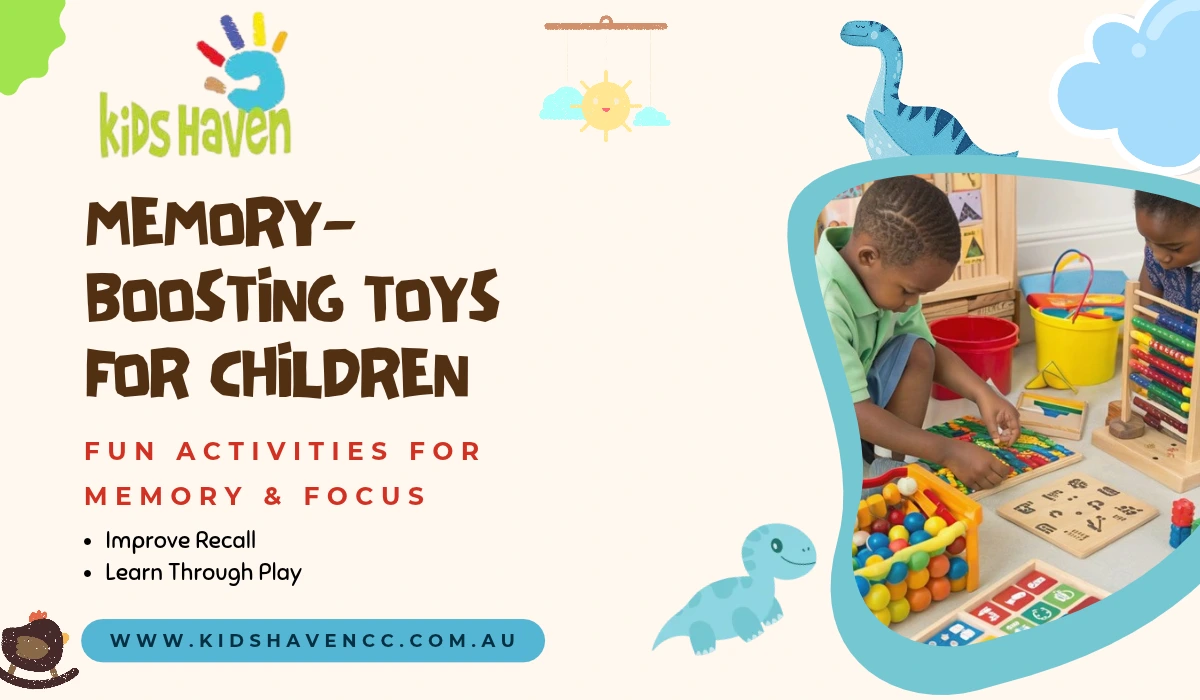
Memory is an important part of early childhood development, helping children recognise familiar objects, remember instructions, learn new words and connect new information with previous experiences.
At Kids Haven, understanding how children learn through play highlights the value of toys that encourage observation, repetition and recall. Activities such as matching games, puzzles, building blocks and storytelling can help children practise remembering patterns, following sequences and solving simple problems. Choosing age-appropriate toys and allowing children time to explore them at their own pace can make everyday play a meaningful part of developing memory skills.
Eight Effective Memory-Building Tips for Children
Simple, engaging play activities can help children practise remembering information, recognising patterns and following instructions. Parents and educators can use these tips to support memory development through everyday learning experiences.
Tip 1: Matching Games That Encourage Visual Memory
Matching games are a practical way to help young children develop visual memory. These games require children to remember where pictures, colours, shapes or objects are located and identify matching pairs.
Start with a small number of cards featuring familiar animals, everyday objects or colourful shapes. Turn the cards face down and encourage your child to find two matching pictures. As their confidence improves, gradually introduce more cards to make the activity challenging.
Memory-building benefits include:
- Recognising and recalling pictures.
- Improving concentration and attention to detail.
- Learning to remember the location of objects.
- Developing patience and turn-taking skills.
For younger toddlers, begin with a few visible matching objects before introducing more complex card games.
Tip 2: Jigsaw Puzzles That Strengthen Recall
Jigsaw puzzles help children remember shapes, colours, patterns and the positions of individual pieces. While completing a puzzle, children use previous observations to decide where each piece belongs.
Choose puzzles with large pieces and familiar images for younger children. Older preschoolers may enjoy puzzles featuring animals, vehicles, letters or everyday scenes. Ask questions such as, “Which piece did you try earlier?” or “What part of the picture is still missing?” These prompts encourage children to recall information rather than simply guess.
Puzzles also support spatial awareness, problem-solving and persistence. For more ideas, explore our related article on toys that support cognitive development in kindergarten.
Tip 3 :Building Blocks for Remembering Patterns and Sequences
Building blocks, stacking toys and construction sets encourage children to observe and recreate designs. For example, an adult can build a simple tower using three coloured blocks and invite the child to copy the same arrangement from memory.
As the child becomes more confident, introduce longer sequences or different shapes. Children can also build a structure, look at it carefully, and then try to recreate it after the original model is covered.
These activities help children practise:
- Remembering the order of colours and shapes.
- Recalling instructions and construction steps.
- Recognising patterns and similarities.
- Developing hand-eye coordination and problem-solving skills.
Choose age-appropriate materials and supervise play carefully, particularly when toys contain small parts.
Tip 4: Storybooks and Puppets That Develop Listening Memory
Picture books, story cards and puppets give children opportunities to remember characters, events and the order in which things happen. Listening to a story and discussing it afterwards encourages children to retrieve information and express what they remember.
After reading a short story, ask simple questions such as, “Who was in the story?” or “What happened first?” You can also use puppets to act out familiar scenes and invite your child to retell the story in their own words.
Repeated storytelling supports recall, vocabulary and comprehension. For additional creative ideas, explore these arts and crafts activities for kindergarteners that can complement story-based play.
Tip 5: Sorting Toys for Recognition and Categorisation
Shape sorters, colour-sorting sets and simple object collections help children identify similarities and remember categories. For instance, children can sort toy animals, group objects by colour or place different shapes into matching spaces.
Once they understand the activity, change the arrangement and ask them to repeat the sorting task. You can also remove one object from a group and ask which item is missing.
These simple challenges encourage children to observe details, remember characteristics and retrieve information. They can be adapted for different developmental stages by changing the number of objects or introducing additional categories.
Tip 6: Musical Toys That Help Children Remember Sequences
Musical instruments, rhythm toys and action-song games combine listening with movement. Children can practise remembering a short sequence of sounds, claps or actions and repeating it in the correct order.
For example, clap twice, tap your knees once and ask your child to copy the pattern. Familiar songs and nursery rhymes also help children remember words, rhythms and repeated phrases.
Explore our guide to how music and movement support early childhood development for more ideas that combine physical activity with learning.
Tip 7: Simple Ways to Make Memory Games More Effective
The way a toy is used can be just as important as the toy itself. Parents and educators can make play more meaningful by allowing children time to observe, think and try again without pressure.
Consider these practical approaches:
- Keep activities short: Choose games that suit your child’s attention span.
- Repeat familiar games: Repetition gives children more opportunities to practise recall.
- Ask open-ended questions: Encourage children to explain what they remember.
- Increase difficulty gradually: Add more pieces, cards or steps as skills develop.
- Celebrate effort: Recognise concentration and persistence instead of expecting every answer to be correct.
- Allow independent play: Give children time to explore and solve problems at their own pace.
You can also introduce memory-building activities through fun and educational activities for kindergarteners at home.
Tip 8: Choosing Age-Appropriate Toys for Different Stages
Children develop memory at different rates, so toys should reflect their current abilities, interests and safety needs.
| Age group | Suitable toys | Memory skills practised |
|---|---|---|
| Babies and young toddlers | Large soft blocks, sensory toys and familiar picture books | Recognition and familiarity |
| Older toddlers | Simple shape sorters, stacking toys and matching objects | Recall, categorisation and patterns |
| Preschool children | Picture-card games, puzzles, story cards and construction sets | Visual memory, sequences and storytelling |
| Kindergarten-aged children | More complex matching games, multi-step building challenges and board games | Working memory, planning and recall |
Always check the manufacturer’s recommended age range, inspect toys for damage and avoid small parts that could present a choking risk.
Parents comparing early learning options can also read about the differences between three-year-old and four-year-old kindergarten programs to understand how activities can suit different developmental stages.
Help Your Child Build Memory Skills Through Play
Memory-building toys can help children develop concentration, recall, logical thinking, and problem-solving skills through enjoyable play. With suitable toys and engaging activities, children can practise remembering patterns, exploring ideas, and building confidence at their own pace.
Kids Haven provides a play-based learning environment for children in Campbellfield. Contact Kids Haven on (03) 9359 0022 or 0430 354 488 to learn more about its childcare and kindergarten programs.